Suppose you are building a booking service for a small studio. You describe the features to an AI: let customers choose a time, collect their details, send a notification, and give the owner a place to manage appointments. As those requests become working screens, an idea that once felt distant starts to look like a product.
Then the owner asks: “When someone reschedules at the last minute, do I still have to update three different places?”
That question brings the product back to the work it is supposed to help with. The screens work. The job may be no easier. The studio in this essay is a hypothetical example, a way to explore how products can explain their reason for existing as AI makes parts of implementation easier.
As code recedes, whose attention changes?
For most users, code has always been in the background. They already cared about making a booking, finding information, and getting something done. Those needs predate generative AI. A change in tools does not automatically change them.
The newer shift is on the creator's side. For some tasks, requirements that once had to be translated into code step by step can now be described in natural language, then refined through execution, screens, and feedback. This creates room to move attention toward what should happen, whether the result meets the need, and where intervention is still necessary.
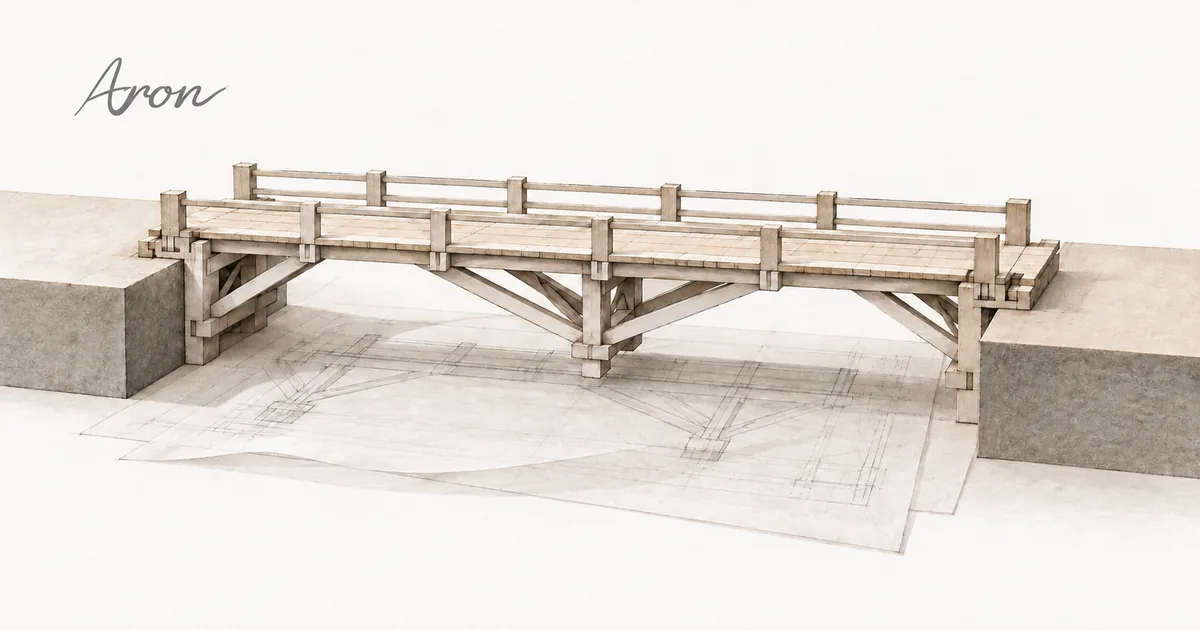
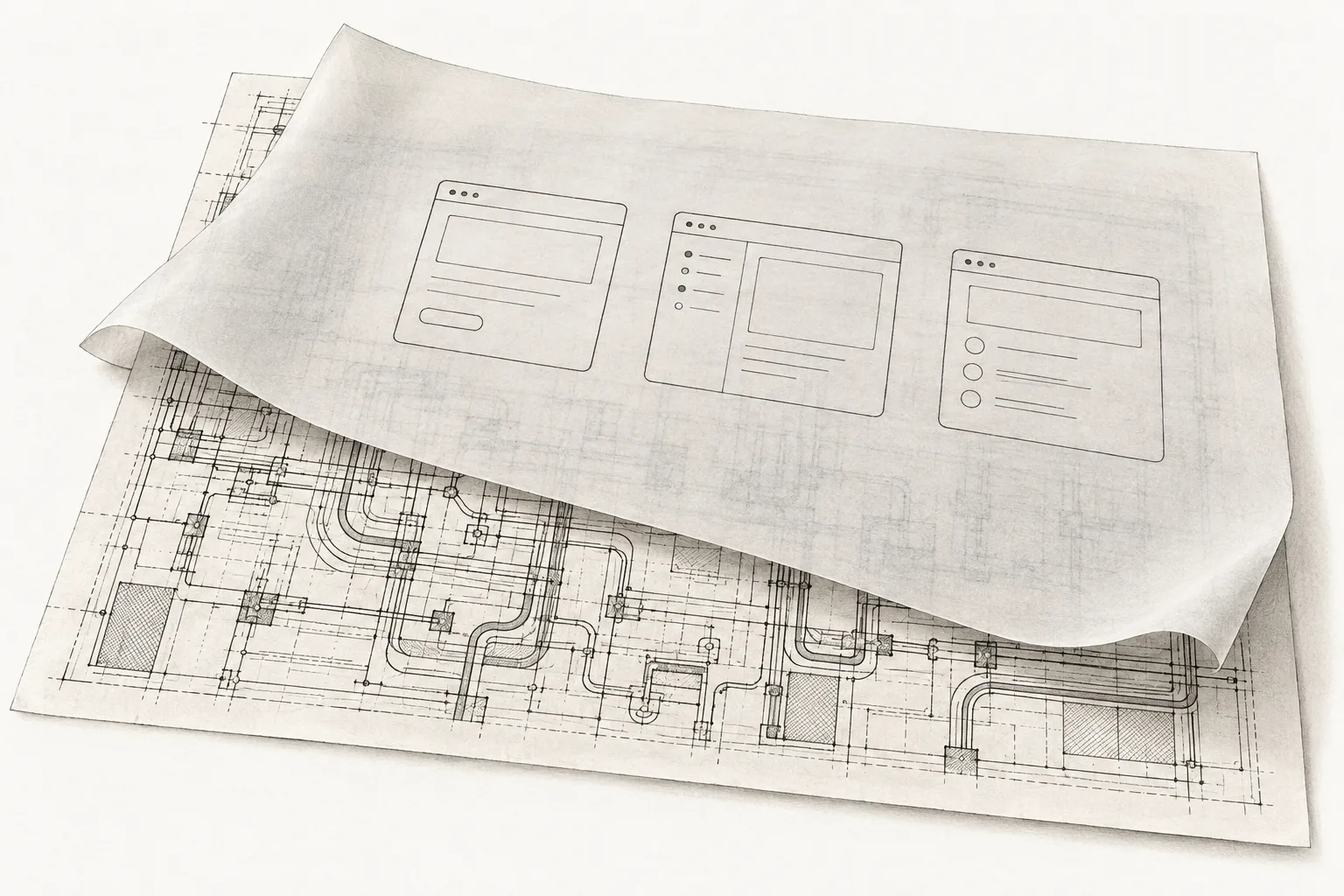
I think of this as AI drawing a screen over the code. Part of the implementation process becomes less visible, while the data structures, operating conditions, and errors remain underneath. When a result goes wrong, someone still needs to identify the layer responsible and be able to open it up.
There is an easily overlooked condition here: you need to know what completion means. “Build a booking system” is easy to say. Specifying what should happen when two people try to claim the last available appointment begins to define the product's boundaries. Every gap in a requirement will eventually be filled by someone's decision or by the system's behavior.
Faster implementation turns those gaps into concrete behavior sooner. As screens become more complete, a team can mistake a default for a decision it has already discussed. A working result deserves another look: which rules came from an actual need, and which were simply chosen during generation?
What distinguishes a product once it can be built?
When a type of feature becomes easier to implement, it is worth reexamining how much differentiation comes from having it. Booking forms, notification templates, and management screens are useful. As similar combinations become easier to produce, users have more reason to compare how well each fits their work, how difficult switching would be, and whether help will be available when something fails.
My view is that AI will put more pressure on certain advantages sustained by the difficulty of implementation. That claim has limits. Features that are easy to describe, easy to verify, and supported by established patterns face different conditions from systems that depend on unusual algorithms or deep domain knowledge.
Products have always needed to create value for users. What changes is the reasoning behind where we spend our effort. As the cost of adding a feature falls, teams can drift into an endless search for what else they could include. The user's cost of understanding options, configuring rules, and migrating data may stay the same. For the studio owner, another option can simply mean another decision to make.
Greater implementation capacity therefore makes prioritization more concrete. Are you willing to serve a particular kind of studio? Would you give up a supposedly universal feature to make its workflow clearer? The easier it becomes to build, the more useful it is to ask whose burden each addition actually reduces.
In its 2026 survey of technical workers, METR distinguished speed gains from the value of work produced, while cautioning that self-reported gains are not objectively established effects. The survey does not tell us which products will succeed. Its measurement distinction is useful here: finishing an unwanted admin screen faster can still amount to spending attention faster.
This affects what is worth accumulating. Understanding a studio's work can become sensible defaults, appropriate handling of exceptions, and a process that is easy to adopt. A competitor may copy the screens without understanding why each choice was made. That understanding needs continued contact with real work. When it becomes merely an internal assumption, it can become a burden too.
From a booking feature to a confirmed appointment
Return to the studio. Suppose its sole owner serves customers during the day and answers messages at night. Requests are scattered across a messaging app, a calendar, and paper notes. The owner wants less back-and-forth while keeping the flexibility to accommodate regular customers and unusual requests.
A form that accepts submissions solves a data-collection problem. Confirming an appointment involves more decisions. Is preparation time needed before or after a service? Is the chosen slot still available? When a customer reschedules, when does the old slot become available again? If a notification fails, who knows that the process remains unfinished?
These details change how the product operates. If calendar synchronization is delayed, the service should not announce a successful booking based only on stale information. If the owner must review a special request, the interface needs to distinguish “request received” from “appointment confirmed.” Those two messages can determine whether someone leaves home expecting to be served.

The product's positioning becomes clearer as we identify the part of the work it should improve. Features still matter. They need to connect to a promise and to evidence that the promise is being met.
| Feature | Promise to the user | How to evaluate it |
|---|---|---|
| Time-slot selection | Customers choose times when the service can actually be provided | Check conflicts and duplicate bookings; track the share requiring manual correction |
| Rescheduling | One change keeps the relevant records consistent | Observe the actions and back-and-forth messages needed for a change |
| Notifications and reminders | Both parties understand the current status and next step | Check delivery, misunderstandings, and the need for manual follow-up |
There are no impressive target numbers built into this table. In a real deployment, we would first observe the existing process, then examine the difference after adoption, including time spent on setup, checking, and recovery. If fewer messages are exchanged but the owner must check every day for AI mistakes, the time saved may return as a different kind of work.
Promises also need to stay within the product's influence. A reminder can help customers remember an appointment; it cannot guarantee that everyone will arrive on time. A responsible approach makes observable status clear, helps the owner identify unconfirmed appointments early, and leaves room to contact people and adjust plans. Precision about the outcome shapes the expectations users build.
Understanding the setting also changes the competitive comparison. This service may be competing with a familiar messaging app and a paper calendar. It has to be useful enough to justify abandoning an established habit. Feature parity is only one part of that decision.
What should an interface reveal when work is delegated?
When the owner can say, “Move Friday afternoon's appointments to next week,” the product begins accepting delegated work. The sentence leaves out many operations and just as many conditions. Does it mean every appointment? Have the customers agreed? Are there enough suitable slots next week?
A useful interaction brings those conditions back into a form the owner can assess. The system could list affected appointments, propose available times, and let the owner review them before contacting customers. Items that cannot yet be arranged need an explicit status and a way to take over. Understanding where the work stands is part of being comfortable handing it off.
This also shows the limits of a chat box. Natural language is useful for stating intent and adding context. A calendar can make a week's availability easier to compare. A table showing the before and after of several changes can make review easier. An interface can use different forms for describing, comparing, and confirming, according to the task.
The information behind a decision should also be inspectable. Does “the afternoon is free” come from the latest calendar, or from something the owner said last week? A product need not expose every step of reasoning. It should provide verifiable information and constraints where they affect an arrangement, so the user knows which condition to correct.
Control also includes the ability to change one's mind. Can a notification be canceled before it is sent? Can a correction follow afterward? Is the scope of automatic action clear? These questions belong in the design of the workflow, because their answers affect how much the user is willing to delegate.
If every step requires another check, the benefit of delegation shrinks. If everything happens silently, the user may lose an essential opportunity to make a decision. The product needs to identify the moments worth pausing at and keep the status of the remaining work visible. That is a design problem tied to a particular situation. “Automate more” is too broad an instruction to resolve it.
The engineering you cannot see still shapes the experience
A simple interface leaves more responsibility with the system beneath it. When two customers book simultaneously, the records need to remain consistent. Retrying a notification must not produce contradictory messages. After an interruption, whoever takes over needs to know which actions have already happened.
This work can be hard to show in a demo, yet it repeatedly determines trust in everyday use. Once a product acts on someone's behalf, an error can leave the screen and disrupt another person's plans. Engineering quality becomes part of the product's promise.
In its 2026 account of building Managed Agents, Anthropic described separating durable event records from execution environments so work could recover after component failures. It is a concrete example of the state management and recovery needed behind a simpler interface. It does not imply that a booking service should adopt the same architecture.
Engineering can also remain a product's strongest differentiator. Very low latency, specialized data processing, offline operation, or difficult integrations can determine whether a need can be met at all. Treating all code as an interchangeable commodity overlooks these specific constraints.
What matters to me is whether a team can explain how each technical investment improves the outcome. For this studio, reliably preventing duplicate bookings may deserve attention before adding another tone for generated messages. Fixed rules may also be better suited to a known process than asking a model to decide afresh each time. Knowing where AI helps and where certainty is needed is itself a product capability.

Rewrite the product's promise
If we introduced this hypothetical service as “a booking platform with AI scheduling, automated notifications, and intelligent management,” we would describe features while leaving the owner to infer their relevance to the current situation.
I would try something more specific: “Help independent studios manage bookings and changes in one place, reduce repeated coordination, and let the owner step in where judgment is needed.” This is a promise to test through design and use, rather than an established result. It names the audience and gives the team a clearer basis for deciding what to do first.
A narrower scope also makes a first step easier to evaluate. Start with one complete rescheduling process for a one-person studio: releasing the old slot, updating records, and sending the notification. Staff scheduling can come later. This sequence gives the team a chance to learn from actual use, instead of treating a feature count as evidence that it understands the problem.
Four questions follow. Who are we serving, and how do they do this work today? Which observable outcome should improve? What evidence would show that the improvement happened? When the system cannot finish, who takes over, and how is the situation repaired?
Those questions can guide every feature decision. If an addition only makes the product appear more intelligent and connects to none of the answers, it deserves to wait. Time saved in implementation can go toward observing real work, simplifying setup, or making failure easier to recover from.
For designers and developers, this strengthens the connection between their work. Defining a problem requires an understanding of technical limits. Choosing a technical approach requires knowing the outcome users care about. Design turns those choices into a process people can understand, use, and trust. Whoever connects those concerns has an opportunity to create value that a feature list cannot adequately describe.
As AI makes parts of implementation easier, I hope we gain more room to work: to test a worthwhile problem earlier, and to deal patiently with the exceptions that are hard to demonstrate but happen every day.
Code can move into the background. When that studio owner faces another last-minute change, handles it once, and can see that the work is complete, the product has earned a reason to be chosen again.