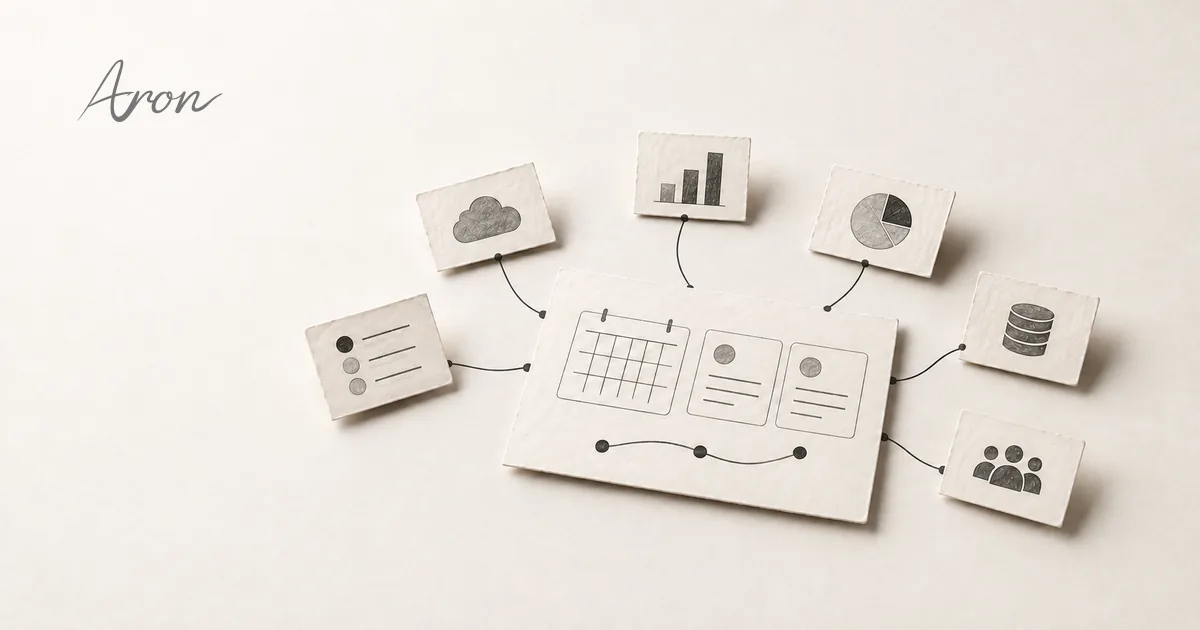
Suppose you are planning a weekend trip with friends and someone changes their availability just before departure. You open a messaging app to confirm the new dates, a booking service to check trains, and another service to see whether the hotel can move your reservation. The calendar still shows the old itinerary. The meeting time in a shared document needs updating too. Each app does its part. You are still responsible for putting the trip back together.
This hypothetical situation points to a concrete problem. We want to get one thing done, but software often offers pieces of capability scattered across separate places. Memory, copying and pasting, and repeated checks supply the missing connections.
AI now makes it easier for more people to turn small needs into applications. New trip assistants, summarizers, trackers, and admin tools can appear more readily. That creates possibilities, along with a question: as solutions multiply, does using them make life simpler?
My view is that the amount of software may keep growing while the number of interfaces people have to operate themselves can fall. That transition depends on technology, business incentives, and trust moving together. This article examines the evidence and conditions behind the prediction, using sources available as of October 2026.
Why does a need so often become an app?
There are practical reasons to make a standalone product. Ticketing services manage seats and transactions; hotel platforms maintain room availability; messaging services hold relationships. Their data, rules, and responsibilities differ. A dedicated interface makes each complex domain manageable.
Product boundaries also follow commercial boundaries. Accounts identify customers, subscriptions and transactions generate revenue, and notifications and home screens invite another visit. An independent entry point lets a provider build a brand, reach customers, and retain control over features and pricing.
The software landscape therefore reflects both people's needs and how suppliers organize themselves. A trip crosses several systems because no provider naturally holds all the information or necessarily wants all the responsibility. Some of the fragmentation users feel comes from these reasonable but separate boundaries.
New needs have never led only to new apps, of course. Spreadsheets, browsers, software suites, and extensions have long brought different activities into shared environments. Specialist tools can work together through integrations. Software has always moved between separation and consolidation; its history cannot be reduced to a new platform for every new requirement.
AI adds a different condition: more small, temporary, personal needs can become candidates for dedicated software. A tool that once seemed too minor to justify weeks of development may now reach a usable first version. As these tools accumulate, the question of who makes them work together becomes more pressing.
Apps are multiplying. What do the numbers establish?
RevenueCat's State of Subscription Apps 2026, citing Appfigures, reports that monthly launches of subscription apps rose from about 2,000 in January 2022 to more than 14,700 in January 2026—roughly seven times as many. These are mobile subscription apps, not a count of all websites, enterprise software, or AI-generated tools. Source: RevenueCat / Appfigures
Monthly subscription app launches: two snapshots
By early 2026, monthly additions were roughly seven times the level four years earlier.
- January 2022 (about)2,000
- January 2026 (more than)14,700
View app launch data
| Month and qualifier | New subscription apps / month |
|---|---|
| January 2022 (about) | 2,000 |
| January 2026 (more than) | 14,700 |
Two benchmarks from the report's text, not a complete monthly series. The 2022 figure is approximate; the 2026 bar ends at the 14,700 threshold, below the reported actual count. Coverage is iOS / Android subscription apps. The data do not identify how many were built with AI.
SourceThe figures support rapid supply growth in one category of software. They do not identify which apps AI wrote, or establish that AI caused the entire increase. Coinciding growth in launches and development tools leaves a causal relationship still to be tested.
Another source looks more directly at production. In 2025, Anthropic analyzed 500,000 coding interactions across Claude.ai and Claude Code, finding web development languages and user interface work among common uses. That shows AI being used to make applications people interact with. It describes Claude usage, however, and cannot be converted into a worldwide count of successfully launched products. Source: Anthropic
Two frequently conflated categories also need separating. An app built with AI assistance may contain no AI features. An app whose main feature uses AI may have been developed through conventional engineering. Research on the revenue or retention of AI products cannot directly establish the quality of software written by AI.
Taken together, the evidence supports a narrower conclusion: software supply is expanding quickly in parts of the market, and AI is participating in its production. How much of that supply users can absorb, and which tools deserve a lasting place, require evidence from the demand side. Producing an app that works and persuading someone to manage another app are different thresholds.
The burden can sit outside the features
Return to the trip. Even if every tool is well designed, you still need to know where the latest information lives, which booking to change first, and which friends have yet to confirm. A more attractive hotel screen may leave all that work intact.
The costs arrive at different stages. Before adoption, people compare plans, prices, and credibility. Getting started involves accounts, permissions, and learning. Ongoing use brings context switching, moving information, and explaining the same situation again. Later come decisions about subscriptions to keep and records to export. Feature lists rarely capture these costs well.
There are relevant signals in the workplace. Microsoft's 2025 Work Trend Index surveyed 31,000 knowledge workers across 31 markets; 48% of employee respondents said their work felt chaotic and fragmented. This is a self-reported experience among a specific working population. It does not mean half of everyone is tired of apps, or establish that the number of tools caused the feeling. Source: Microsoft
An earlier CHI 2008 experiment offers a useful caution. Under interruption, measured work time was shorter after subtracting time spent on the interruptions themselves, while participants reported more stress, frustration, and effort. The study involved 48 participants, 81% of them German university students, performing controlled, simulated office tasks. It cannot measure the prevalence of app fatigue today. Study: The Cost of Interrupted Work
The next two charts show time and stress separately, keeping the same order for the three conditions. The useful contrast is between speed and experience. Small differences between the two interruption conditions do not establish which type is more harmful.
Net work time was shorter under interruption
These times exclude the interruptions themselves; they are not total elapsed completion times.
- Uninterrupted22.77
- Same-context interruption20.31
- Different-context interruption20.6
View net work time data
| Experimental condition | Mean net work time (minutes) |
|---|---|
| Uninterrupted | 22.77 |
| Same-context interruption | 20.31 |
| Different-context interruption | 20.6 |
Means from 48 participants who experienced all three conditions; variation is not plotted. Same-context interruptions concerned the main task's subject. This chart does not establish an overall time saving from interruptions.
StudyIn the same experiment, reported stress was higher
Both interruption conditions had higher stress ratings than the uninterrupted condition.
- Uninterrupted6.92
- Same-context interruption9.46
- Different-context interruption9.13
View reported stress data
| Experimental condition | Mean stress rating (1–20) |
|---|---|
| Uninterrupted | 6.92 |
| Same-context interruption | 9.46 |
| Different-context interruption | 9.13 |
Ratings run from 1 (low) to 20 (high); bars show means from a zero baseline. This is a subjective scale, so score differences should not be converted into a percentage increase in stress. It is not a survey of today's consumers.
StudyMeasuring speed alone can miss what people expend to maintain it. Equally, an interface that promises to save time should bring waiting, checking, and mental effort back into the evaluation.
There is reason to take fragmentation and interruption seriously, without declaring that AI apps have exhausted everyone. I see a pressure to watch: when the work a new tool saves is smaller than the work of choosing, configuring, and coordinating it, people have a reason to seek an easier arrangement.
AI may also intensify that pressure. If every app gains an assistant that needs its own briefing, users acquire several more conversations to manage. Better local capabilities can still leave more coordination overall.
An interface organized around the task
In “When AI Makes Building Easier, Why Choose Your Product?,” I explored how products take responsibility for outcomes. Looking across products raises another question: can people start with their goal and have the system bring the necessary capabilities into view?
For the rescheduled trip, you might first state the new dates, travelers, and acceptable cost. With access to the itinerary you have authorized, the interface gathers the adjustable pieces: a calendar shows conflicts, a table compares trains and rooms, and friends who have not confirmed remain visibly unconfirmed. Before payment or an irreversible change, it presents the concrete consequences for your decision.
This imagined interface has three jobs: understand the goal and constraints, coordinate the services behind it, and show an appropriate view for the decision at hand. Natural language helps explain why plans must change; calendars show time; tables expose differences. Frequent actions deserve stable positions so familiar operations remain quick.
Early implementations point in this direction. Google introduced generative interfaces in 2025, with models creating interactive pages and tools from requests. The research also acknowledged that generation could take over a minute and produce errors. Its preference evaluation excluded generation time, so it cannot establish better everyday efficiency. Source: Google Research
Interactive tools launched in Claude in January 2026 brought services such as Asana and Figma into conversations. They illustrate another form of integration: existing products contributing capabilities to a shared place of work. The announcement establishes an available implementation direction; lasting reductions in effort still require usage research. Source: Claude
From here, some small tools could appear only for the duration of a task and then recede. The itineraries, documents, and action records they leave must remain available to save, share, and reopen. Otherwise, finding an app becomes finding something buried in a long conversation.
The ability to generate an interface also does not make continual redesign desirable. If the confirmation button moves every day, relearning can quickly consume the time saved. A more plausible direction combines stable interaction patterns with adaptable content, allowing the interface to follow the task while retaining familiarity.
What still stands in the way?
Reliability comes first. A travel assistant might find a cheap ticket but misread the arrival date, or change transport while the hotel is still awaiting a response. Work across services carries several states at once. The interface must reveal what succeeded, what failed, and what needs human attention. A shared screen does not automatically create shared responsibility underneath.
Ease of use should therefore be measured across the whole job: connecting accounts, supplying context, waiting, reviewing results, and repairing mistakes, along with the mental effort of continued supervision. Saving ten clicks may not be worthwhile if you must read three pages to check that the room was booked correctly. Reusable setup is one way benefits could accumulate over repeated tasks.
Direct manipulation has value too. Someone fluent in a spreadsheet may finish with a drag faster than by describing a request. Design, editing, and engineering tools need precise control. In games, social activity, and content browsing, the experience itself can be the purpose. Specialist and dedicated interfaces retain strong reasons to exist.
Then there are business incentives. Will a travel platform let another interface own the customer relationship? Which data and actions can an integrator access? When an assistant recommends something, which options appear and what influences their order? Technical connectivity does not ensure commercial willingness.
Concentrated access can create new dependencies. If preferences, history, and permissions collect in one place, switching providers may become harder. People need to know whether they can take their data with them, inspect the basis of recommendations, and choose another provider. As interaction becomes easier, these less visible choices remain worth protecting.
I am therefore skeptical that everyone ends up using one app. Personal life, company work, professional creation, and entertainment have different data boundaries and interaction needs. A few familiar entry points alongside specialist tools seem more plausible. How well those entry points connect remains an open competitive question.
What I will watch over the next five years
These are my judgments from October 2026. The periods organize observation rather than promise precise deadlines. Confidence is a relative assessment, not a statistical probability.
| Period | Prediction / confidence | What to observe |
|---|---|---|
| 2026–2028 | Existing interfaces integrate more services; higher | Fewer switches; less total time including checks and corrections |
| 2028–2031 | Some tasks get interfaces assembled on demand; moderate | Results support saving, collaboration, reuse, and exceptions |
| Longer term | Multiple entry points plus specialist apps: moderate; one global interface: low | Data portability, interoperability, and commercial willingness |
I am more confident about the first because it can proceed incrementally through existing services. Users can start by delegating search, organization, and drafting, then expand delegation as results justify it. Software behind the scenes can multiply while the paths a person needs to understand grow shorter.
The second must bridge the distance between demonstration and daily use. Generating an attractive travel page once is different from finding the booking records three months later and editing them with companions. I would look for repeat use, less manual transcription, and data that remains usable after tools change.
Over the longer term, ownership of the entry point is least settled. Model capability is only one condition; data, permissions, distribution, and trust matter too. Specialist services may become capabilities called by others, retain their own interfaces and customer relationships, or do both. A single technical metric will not decide this.
The predictions also need room to fail. If delays, mistakes, and supervision keep sending people back to their existing apps, the case for consolidation must narrow to specific situations. Even growing adoption cannot establish ease of use if total burden does not fall.
Let the tools recede so the task can move forward
For product teams, this future suggests more concrete questions than what else to build. What can users stop remembering, explaining repeatedly, waiting for, or fixing? Sometimes the answer will be a feature, sometimes an integration, and sometimes making the product's capabilities dependable from another interface.
Return to the trip. A better outcome would let you explain a change once, compare options clearly, see who has yet to confirm, and make the decisions that need you. Afterward, the itinerary and records remain somewhere you can find them and take them with you.
There may still be a great deal of software underneath, perhaps more than today. The difference is that you no longer have to act as the connection between every service yourself. That is the standard I would use to judge whether the next interface represents real progress.